This July, Kevin Hatala (Chatham University), Neil Roach (Harvard University) and Louise Leakey (Stony Brook University) led a TBI team unearthing a new early Pleistocene footprint site at Koobi Fora. The first tracks were discovered last year by Louise’s team at the bottom of an important skeletal fossil excavation. This year’s excavation uncovered a large surface with tracks of multiple hominins, bovids, equids and large, extinct wading birds.
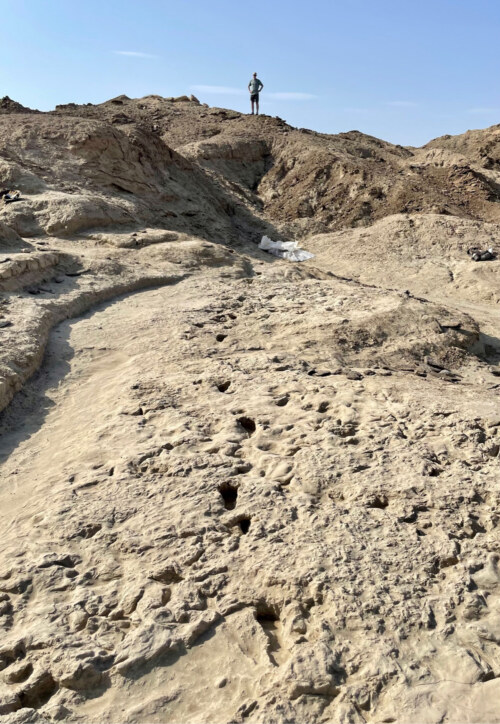
Kevin surveying the trackway excavation. (Credit: N. Roach)
Such fossil footprint sites are remarkably precise, Polaroid-like snapshots of prehistory. Experiments we have conducted along the shore of modern Lake Turkana show that these footprint assemblages often accumulate over the course of hours to a few days at most, far different from the bony fossil assemblages for which the Turkana basin is famous, which accumulated over tens of thousands of years or more. Furthermore, these trackways are faithful records of hominin presence at a specific place and time and they can provide important information about how our ancestors moved around the landscape and the types of animals they interacted with.
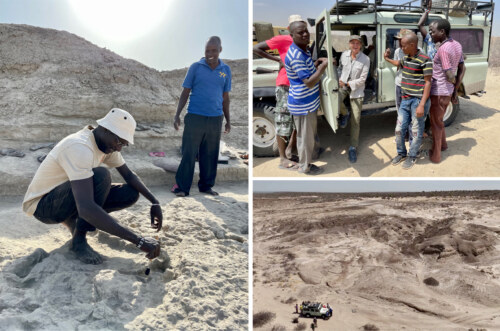
Left: Loki and Apollo having a laugh during excavation; Upper right: Louise finding some elusive shade while flying the drone; Lower right: Drone photo of the track site and surrounding deposits (photo credits: N. Roach, L. Leakey)
Until quite recently, fossil hominin footprints have been viewed as rare curiosities in paleoanthropology, rather than as substantial sources of important and unique information about our evolutionary history. There have been some (very important!) flashes in the pan, such as the iconic 3.66 Ma hominin footprints discovered by Mary Leakey and team at Laetoli, Tanzania in the late 1970s (which confirmed bipedality as a early defining feature of hominins), and the 1.4 Ma hominin footprints found by Kay Behrensmeyer and colleagues at about the same time near Koobi Fora, Kenya. However, for the multiple decades that followed those famous discoveries, the attention of paleoanthropologists was focused overwhelmingly on skeletal fossils and stone tools.
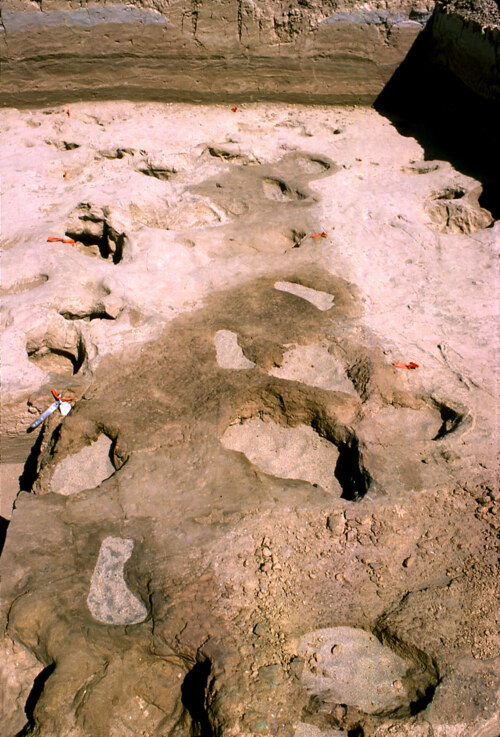
Photo of the ~1.4 Ma hominin trackway that was uncovered at Koobi Fora from 1978 to 1979 (Photo credit: A.K. Behrensmeyer)
Within just the past decade or so, this pattern has started to change, as fossil footprint discoveries have surged in frequency and researchers have developed new analytical methods to learn much more from them. Over the past few years, footprints have brought us information on Neanderthal social groups in France, on humans migrating through a green Arabian peninsula, and on people hunting giant sloths in Pleistocene North America. We could go on with many more examples!
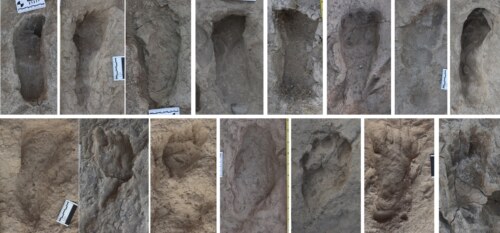
Some of the ~1.5 Ma hominin tracks previously found by our team near Ileret that inform our understanding of the evolution of human locomotion (image: Hatala et al., 2016)
We, and our colleagues, have been uncovering new early Pleistocene fossil footprint sites throughout the Turkana Basin, and have been working to understand what these fossil data can tell us about hominin anatomy, the mechanics of how they walked and the structure of their habitats. Most of our ongoing work focuses on the time period around 1.5 Ma, when Homo erectus, Homo habilis, and Paranthropus boisei co-existed on some of the same landscapes in the Turkana Basin. During this time, conditions were ideal for hominins and their surrounding animal communities to make footprints that were preserved and found their way into the geological record. Over the past 8 years, we have identified dozens of footprint sites in the Koobi Fora Formation, excavated many, and learned new things about early Pleistocene hominin locomotion, group behavior, and other aspects of their paleobiology. They’ve also revealed fascinating insights about hominin environments and the animal communities of which they were a part.
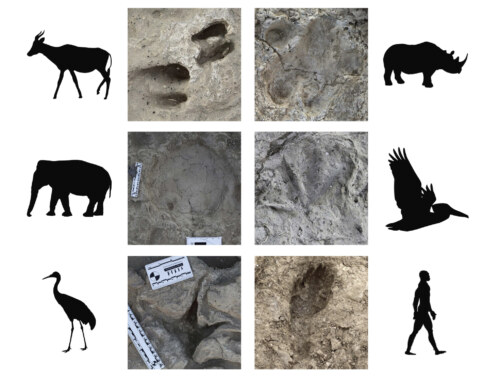
Hominin footprints in the Turkana basin are often accompanied by the tracks of other animals, giving insight into the faunal community in which they lived (image: Roach et al., 2016)
Article authored by: Kevin Hatala and Neil Roach.